National Cemetery
Fort Rosecrans
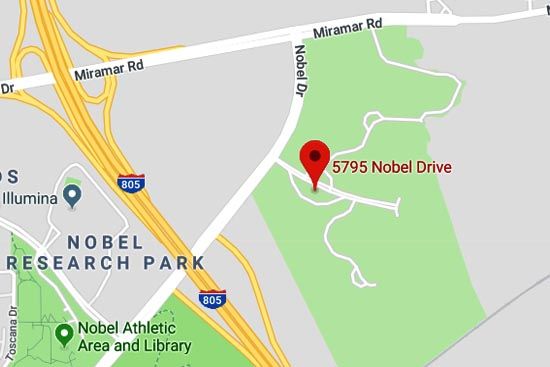
Miramar Cemetery
131 National Cemeteries – 3 are in Southern California
A national cemetery is the final resting place of many brave men and women who fought for their country. With rows of white tombstones, these well-kept graveyards provide strong remembrance of those who have died. We should give thanks for their sacrifice in serving this country. The gravestones and monuments tell stories of bravery, strength, and teamwork. They are a testament to the lives and the essential things that the people who died accomplished. In southern California, we are lucky to have three military cemeteries.
Two are in San Diego, and Riverside Cemetery is in Riverside, California. Veterans, spouses, and dependents of the veterans reserve burial in these military cemeteries.
There are many benefits for veterans wishing to be burial in a national cemetery, some of which are in the graphic.
The veteran must have an honorable discharge for placement in a national cemetery. However, we urge veterans to apply regardless of their discharge status because there may be exceptional circumstances.
The family can’t be charged for opening or closing fees, an outer burial container, or a grave plaque here. The rest of the funeral costs are up to the family to cover. Not everything is paid for by the Veteran Administration, as some families believe.

Miramar Military Cemetery
A new national cemetery in San Diego, Miramar National Cemetery, was established in 2010 and shared the expansive 313-acre property with protected native wildlife. Miramar National Cemetery will serve the need of veterans for the next several decades. It reserves approximately 1/3 of its area to protect the region’s federally endangered or threatened species, such as the San Diego fairy shrimp, the California gnatcatcher, the Otay Mesa mint, and San Diego button celery.
The Miramar Cemetery has available space for both casket burials and cremated remains. As well, there are many Columbariathe areas for the interment of cremains. We have a separate page for more detailed information on Miramar National Cemetery since it is the one in San Diego in current use.
Miramar National Cemetery currently offers a complementary horse-drawn carriage – a fantastic option to take advantage of.

Fort Rosecrans Veteran Cemetery
Fort Rosecrans is on beautiful Point Loma in San Diego. Before 1934, it was called Bennington Nation Cemetery. It used to be a coastal gun station for the army. William Rosecrans was a Union general in the Civil War, and Fort Rosecrans was named after him, even though he was not buried there. Arlington National Cemetery is where General Rosecran’s body is buried. On its 77 acres, about 112,000 soldiers and their family members are buried at Fort Rosecrans.
It must be one of the most beautiful cemeteries because it looks out over San Diego Bay and the Pacific Ocean. Since 1966, there has not been the first interment for caskets allowed here, and you haven’t been able to bury a cremated body since 2014. On the other hand, Fort Rosecrans is still very busy with second burials of caskets and ashes.
First interment at Rosecrans Possible – Although Rare
Some veterans or their families can be placed at Fort Rosecrans through disinterments and exceptional circumstances. Funerals Your Way was fortunate to assist in a few burials there. Two of these were victims of the Pearl Harbor attack.
Twenty-two people who won the Medal of Honor and died there are buried there. This highest military award goes to people who have gone above and beyond what was expected of them. The metal is given by the president to members of the US troops on behalf of Congress.
Have a look at the article about Fort Rosecrans Cemetery. We encourage you to visit the cemetery. It is a very peaceful and beautiful place that overlooks the Pacific Ocean. There is much history here!
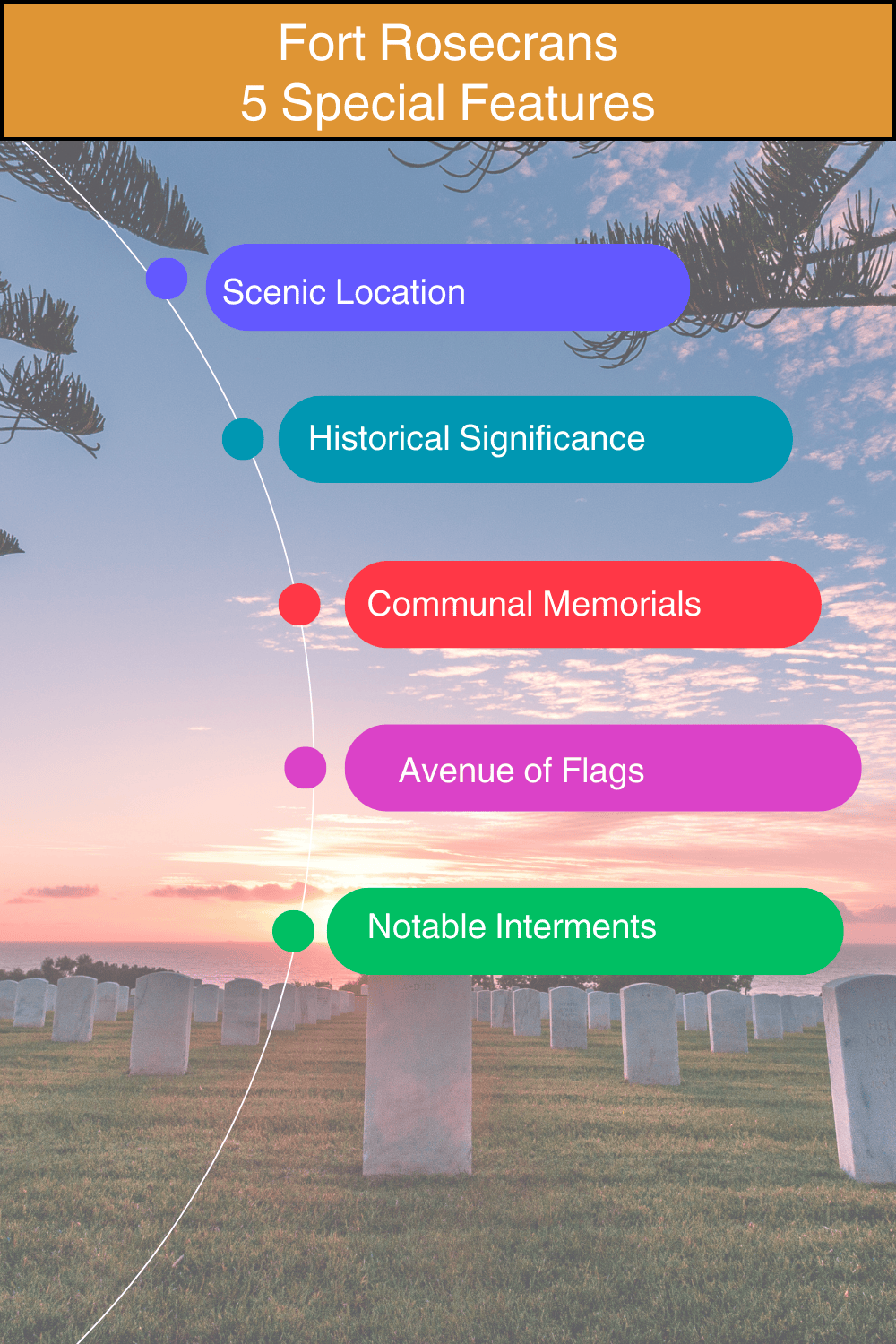
Fort Rosecrans – Special Features
The Fort Rosecrans National Cemetery, a historic landmark in San Diego, California, is known for its unique features, long past, and probably the most scenic cemetery. Here are five things that make Fort Rosecrans Cemetery stand out:
The beautiful Point Loma Peninsula houses Fort Rosecrans Cemetery. From there, you can see the Pacific Ocean and the city of San Diego. The peaceful and beautiful setting is a quiet place for the dead to rest.
The graveyard is named after Brigadier General William Starke Rosecrans, a well-known Union general in the American Civil War. It is essential to history because it has been used since 1882 where and is where thousands of war veterans and their families are buried.
Communal Memorials: The Fort Rosecrans Cemetery has several memorial buildings that honor different groups of people. The most famous is the USS Bennington Monument, built in 1905 to keep the people who died in the USS Bennington boiler explosion.
The Avenue of Flags is one of the most exciting parts of Fort Rosecrans Cemetery. On patriotic holidays like Memorial Day and Veterans Day, volunteers line the cemetery’s main road of the cemetery with more than 1,000 American flags. This is a beautiful tribute to the soldiers and women who died while serving their country.
Famous People Buried at Fort Rosecrans Cemetery: Many are buried thereFort Rosecrans Cemetery. Some of these people are Medal of Honor winners, war heroes, astronauts, and influential people from different military areas of the military. This adds to the cemetery’s historical and cultural importance.
There are many monuments in the cemetery. The USS Bennington Monument, a 60-foot granite obelisk to the crew of the USS Bennington (PG-4), a gunboat whose boiler exploded on 21 July 1905 in San Diego Bay, killing 66 people.
Another monument is to the Morman Battalion. It’s members made the longest military march in U.S. History – over 2000 miles from Iowa to San Diego in 1846 – 1847 during the war with Mexico.
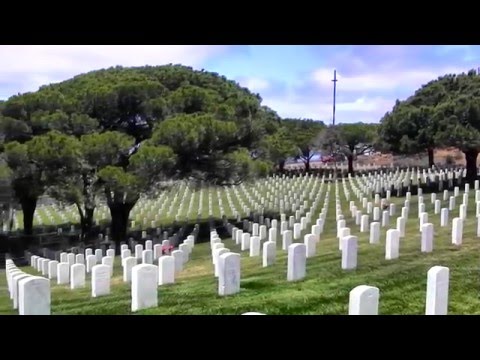
Funerals Your Way has placed many veterans at Fort Rosecrans using caskets and cremains. We have had the honor of placing two veterans killed during the Pearl Harbor attack of 1941
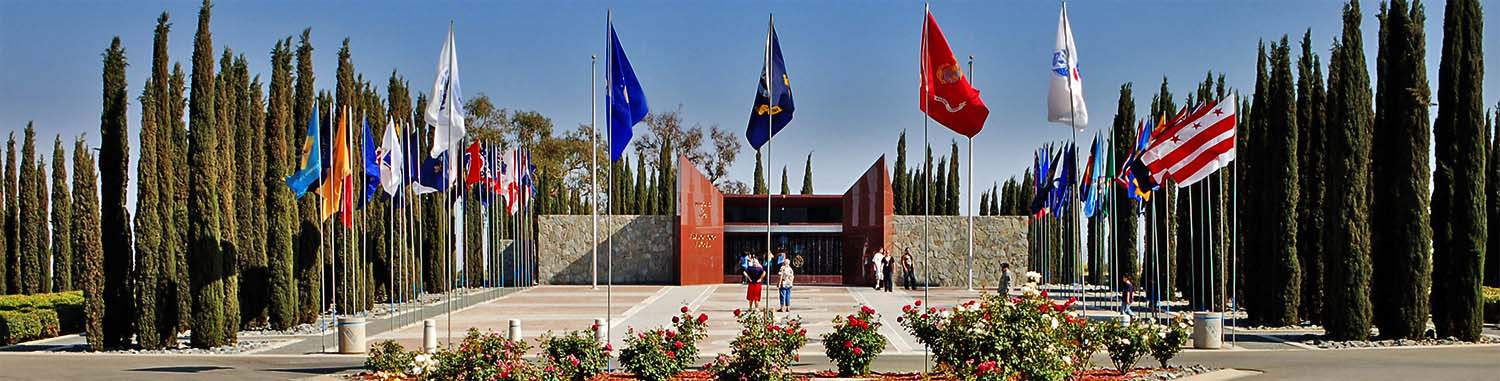
Riverside National Cemetery
The transfer of 740 acres from March Air Force Base allowed the formation of the Riverside National Cemetery. It was dedicated and opened for burials on November 11, 1978. In 2003, an additional 181 acres were added to the cemetery by the Air Force. The cemetery is the third largest managed by the National Cemetery Association and is the most active in the system.
It is especially well-known for its landscape featuring a central boulevard with memorial circles, lakes, indigenous-styled committal shelters, and a memorial amphitheater as described on the website of the U.S. Department of Veterans Affairs.
The cemetery is the home of the Medal of Honor Memorial, featuring the names of all medal recipients, and is one of the four sites recognized as a National Medal of Honor Memorial Site. Also, noted is the Fallen Soldier/Veterans’ Memorial, dedicated to all service members, located near the entrance to the park, dedicated in 2000.
In addition, the American Veterans donated a carillon in 2000. The United States Congress designated another of the cemetery’s memorials as a national memorial in 2004. It was the Prisoner of War/Missing in Action National Memorial sculpted by Vietnam veteran, Lewis Lee Millet, Jr. The bronze sculpture shows an American soldier on his knees with his hands bound.
Many notable Medal of Honor recipients, famous people, and seven Tuskegee Airmen are among those buried at the Riverside Cemetery.
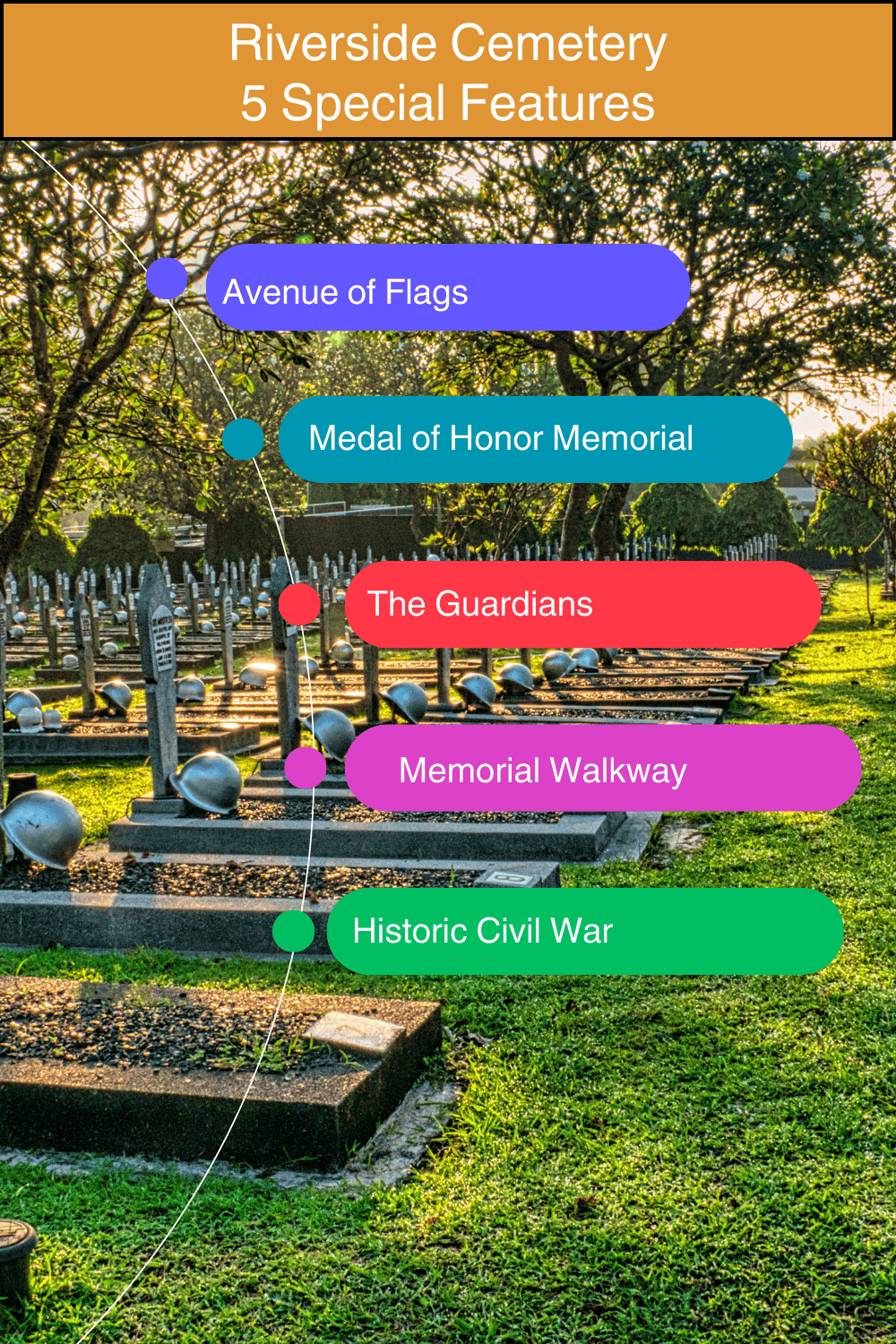
Riverside – Special Features
Avenue of Flags: Riverside National Cemetery features an impressive Avenue of Flags. On patriotic holidays, volunteers place flags along the main entrance road, creating a stunning display of hundreds of American flags that pay tribute to the military veterans interred at the cemetery.
Medal of Honor Memorial: The cemetery has a special place for the Medal of Honor Memorial, which celebrates people who have won the United States’ highest military honor.
The striking bronze figure “The Guardians” is one of the most interesting things at Riverside National Cemetery. This piece of art is bigger than life, and shows four soldgers from the Army, Navy, Air Force, and Marine Corps standing guard over the graves of other soldiers who have passed.
Memorial Walkway: The cemetery includes a Memorial Walkway that showcases a collection of memorial plaques and tributes dedicated to specific military units, organizations, or individuals. These tributes offer a glimpse into the diverse and heroic stories of those who served their country.
Historic Civil War Section: Riverside National Cemetery has a special area for Civil War soldiers called “Soldier’s Circle.” It has a center monument and rows of headstones that show where Union soldiers who fought in the American Civil War are buried. This connects people to the past of the country.