
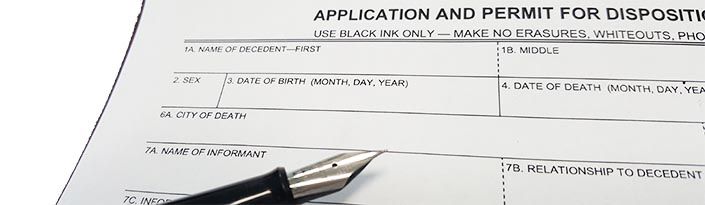
For each death, the state must give a Disposition Permit for the Disposition of Human Remains (also called a “Burial Permit” or “Disposition Permit”). This is needed when the body is going to be buried, cremated, or moved. The state must be aware of the actions taken with the remains and the ultimate resting place of the deceased individual’s remains. If individuals divide the cremated remains for placement at multiple locations, the state authorities must issue a Burial Permit for each site. The following reasons necessitate a burial permit:
- Shipping the remains out of the state or country.
- Scattering cremains on land or burial at sea.
- Deeming the remains for scientific use.
- Shipping the remains into the State of California.
- When disinterment is required for moving the remains to another location other than a new location within the same cemetery.
- When remains are temporarily stored.
Obtaining a Disposition Permit
If is possible to obtain a permit yourself if needed. In our experience this is never required with dealing with the physical body but may be required when dealing with cremated remains. With our Burial at sea company (San Diego Burial at Sea) on occasion families choose to get their own permit. Most often however they just ask us to obtain it for them. It is so much easier if we just do it since we are at the county office several times a week and have much experience in obtains these permits.
The County of San Diego charges $12 per permit.
Obtaining the Permit – in Person
If you would like to scatter cremains (ashes) at sea, tell the county you need to obtain a VS-9 Burial Permit and that it needs to state “at sea off the coast of [insert county of disposition here] County.”
You will need to have the following information and documents with you:
- The decedents full name
- Date of birth
- Date of death
- City of Death
- County (if death occurred in California)/ State (if death occurred outside California)
- An original death certificate or an original transit/burial permit
Payment may be check or money order payable to County of San Diego Public Health Services. Cash will not be accepted.
| Office Location: | HHSA Office of Vital Records 3851 Rosecrans Street. Suite 802 San Diego, CA 92110 |
Obtaining the Disposition Permit – By Mail
Please return the completed permit along with an Original Death Certificate or Original Transit/Burial Permit. If you fail to include these items, your application will be rejected as incomplete and returned to you without being processed.
