
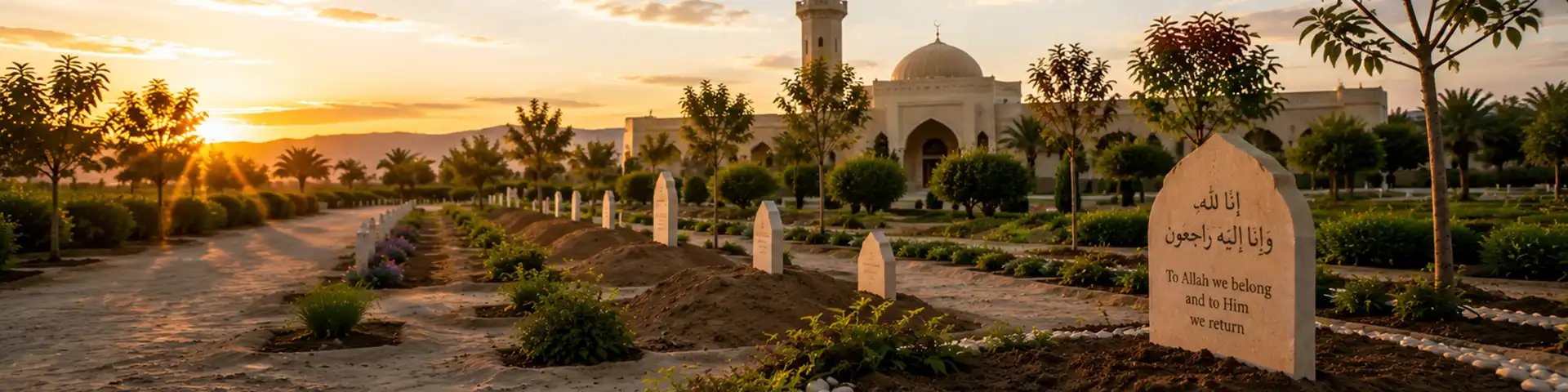
Muslim Burial Services in San Diego
In Islam, death is viewed not as an end, but as a transition to an eternal life. For believers, the passage into the afterlife is an occasion of grave solemnity, one that demands utmost dignity and reverence; and so, Islamic funeral customs are carefully crafted to honor this sacred moment, while drawing strength from the teachings of the Prophet.
Families seeking a deeper understanding of Islamic funeral traditions can also review our detailed guide to Muslim burial practices, which explains the religious foundations and procedures in greater depth.
We’re available 24 hours a day.
When a death occurs, time matters. Our team is ready to assist Muslim families with immediate transportation, permits, and coordination with your mosque or ghusl team — any time of day or night.
Call (619) 550-7807
How we work with the Muslim community
At Funerals Your Way, we do not conduct Islamic rites ourselves. We work directly with authorized members of the local Muslim community, including ghusl teams and mosque representatives.
We provide licensed care, transportation, permits, cemetery services, and logistical time management while leaving the religious rites to those who are authorized to perform them.
Timing & Same-Day Burial
Islamic tradition calls for burial as soon as possible after death — ideally within 24 hours. California law does not prohibit prompt burial, but administrative steps can create delays if families aren’t prepared.
A death certificate must be filed with the local registrar before burial can occur. The attending physician or coroner must certify the cause of death, and the funeral home must file a burial permit. In straightforward cases with a physician available to sign the certificate, this process can be completed within hours.

Delays are more likely when the death occurs under circumstances requiring coroner involvement (unexpected death, death without a treating physician, or death within 24 hours of hospital admission). In these cases, families should communicate the religious urgency to the coroner’s office directly — many California counties have established procedures for expediting Islamic burials.
Our Fees
Our funeral home fees for Muslim burial coordination begin at $ 3595, which covers transportation, permits, death certificate filing, and cemetery coordination. Cemetery costs are separate and vary by location.
Our Role vs. Religious Rites
The following clarifies our role as a licensed funeral home while respecting that Islamic rites are performed by authorized members of the Muslim community.
| We Handle | Religious Rite (Performed by the Muslim Community) |
|---|---|
| Transportation of the deceased | Ghusl (ritual washing) |
| Permits and required certificates | Kafan (shrouding) |
| Cemetery coordination and scheduling | Janazah prayer |
| Grave preparation and logistics | Direction (Qibla) & body positioning |
Muslim Washing
The washing of a Muslim deceased, known as Ghusl al-Mayyit , is an essential ritual performed before burial to ensure purity in accordance with Islamic law. We coordinate with trained members of the Muslim community who are authorized to perform ghusl. For a more detailed explanation of Islamic washing and burial requirements, see our complete Muslim burial guide.
Key Steps in the Ritual Washing:
Preparation : The body is placed on a clean surface, preferably in a private area where only individuals of the same gender as the deceased perform the washing (unless it’s a spouse or close relative). Typically, 2-4 people are involved.
Intention (Niyyah) : The process begins with a verbal or silent intention to perform the washing for the sake of fulfilling the Islamic commandment.
Cleansing the Body :
First, the body is gently washed to remove any impurities. Private parts are covered for modesty, and those washing the body wear gloves.
The body is then washed with water three times or more, depending on necessity. The right side is washed first, followed by the left, and finally, the entire body.
Ghusl (Major Ablution) : After cleansing, the full ablution is performed, similar to how a living person would perform ghusl. This includes washing the mouth and nostrils (if possible), and ensuring water flows over the entire body.
Perfume and Camphor : After the washing, the body is dried and may be perfumed with camphor or other fragrances. This is a Sunnah (recommended practice), as the Prophet Muhammad (PBUH) encouraged using pleasant scents.
Shrouding (Kafan) : The final step involves wrapping the body in a simple white shroud, typically consisting of three large cloths for men and five for women. These cloths symbolize purity and equality in death.
Coordinating Muslim Burial With Care & Respect
We understand that Muslim burial arrangements are often deeply important to families and may require rapid coordination within a short timeframe. Our role is to help manage transportation, permits, cemetery scheduling, and communication with mosque representatives and the Muslim community as respectfully and efficiently as possible.
Understanding Muslim Funeral Traditions
Islam includes several branches and cultural traditions. The two largest branches are Sunni Islam and Shia Islam. While there are differences in religious leadership, prayer traditions, and certain customs, the core funeral and burial practices followed by most Muslim families are very similar.
Sunni and Shia Burial Practices
Sunni Muslims represent the majority of Muslims worldwide, while Shia Muslims make up a significant minority. Both traditions place great importance on:
-
- Prompt burial whenever possible
- Ritual washing of the deceased (Ghusl)
- Wrapping the deceased in a simple white shroud (Kafan)
- Funeral prayers (Salat al-Janazah)
- Respectful handling of the deceased
- Burial in accordance with Islamic teachings
- Avoidance of cremation
While specific prayers and customs may vary, the overall burial process is often very similar between Sunni and Shia families.
Respecting Individual Family Traditions
Muslim families in San Diego come from many countries and cultural backgrounds. In addition to Sunni and Shia traditions, some families may identify with Ismaili, Ibadi, Ahmadiyya, or other Muslim communities.
Because practices can vary by family, mosque, and country of origin, we encourage families to share any specific religious requirements. We work closely with local mosque representatives and authorized members of the Muslim community to help ensure arrangements are carried out in accordance with the family’s wishes.
Muslim Burial Cemeteries
All burials in California must take place in a licensed cemetery. The state’s Cemetery and Funeral Bureau, part of the Department of Consumer Affairs, regulates these facilities under the Health and Safety Code. Private land burials are generally not permitted, though some counties have narrow exceptions for existing family burial plots on rural properties.
Cemeteries must maintain permanent records of each interment and are required to preserve the burial site in perpetuity. When selecting a cemetery, Muslim families should ask whether the facility has a designated Muslim section or can accommodate directional burial — ideally with the deceased’s face turned toward the qibla (Mecca).
Families have a few choices when it comes to selecting a burial site for a more traditional Muslim burial in the San Diego area
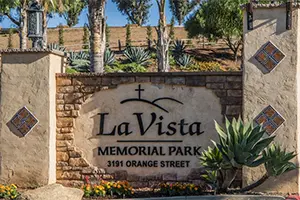
National City, CA
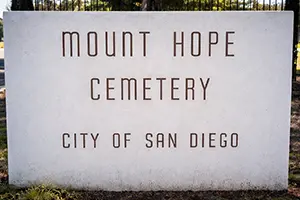
San Diego, CA
They do allow Muslim burial whereby the body in a shroud is placed directly in contact with the earth. A liner is them placed over the body to prevent grave collapse in the future. The body is placed in accordance with Islamic burial requirements.
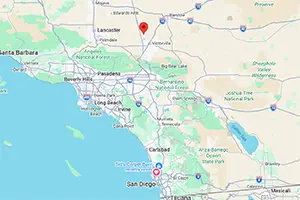
Adelanto, CA
Repatriation & International Shipping
For many Muslim families in San Diego, burial in the United States is not the only option — or the preferred one. Returning a loved one to their home country for burial near family, in a Muslim cemetery, or in accordance with regional traditions is a deeply meaningful choice, and one we regularly assist with.
We handle the full repatriation process, including preparation of the deceased, required documentation, consular coordination, and airline cargo arrangements. Every country has its own requirements, and we have experience navigating them — whether the destination is Pakistan, Egypt, Somalia, Yemen, the Philippines, or elsewhere.
Families considering repatriation should contact us as early as possible. International shipping timelines are driven by embassy and consulate processing, and reaching out promptly gives us the best chance of honoring the Islamic preference for timely burial even across long distances.
👉 Learn More About International Shipping →